FaceTheFacts
Product Design
TL;DR
I designed an app that scans election posters and gives you all the information about the politician in one place. My first real design project, 30k+ downloads, viral on Reddit and TikTok. Four years later I rebuilt it from scratch for my university’s capstone project.
Role
Co-Founder Design, team of 3 students
Type
Non-profit start-up, university project
Impact
10k downloads in month one, 30k+ total
The Palantir for
against
politicians
People often do not know what politicians stand for and who influences them. Election posters are not informative enough to inform oneself deeply.
And who wants to browse through endless pages on the internet to get more specific information on every politician? That’s why we made it our mission to make it as easy as possible to choose the best candidate. How? By showing all the essential information about a candidate directly on the election poster.
Non-profit and open-source.
The pitch
Build & Impact
From an idea to a viral launch days before the federal election.
It all started with an idea: “What if you could scan election posters and see which companies sponsor this politician?”
So we formed a team of CODE students and in August 2020 we were accepted into the UNLOCK Accelerator by Wikimedia, a three-month program for open-source projects. We started with design sprints, built prototypes and ran usability tests with over 50 people. We talked to many experts and non-profit founders from the civic tech space.
How it began
I was the founding designer and owned every step of the design process: research, feature ideas, wireframes, prototypes, and the full UI. My co-founder Victor acted as my main sparring partner.
My role
We launched days before the 2021 federal election and passed 10k downloads in under a month. Downloads passed 30k to date.
Impact
Press & reception
It struck a nerve.


Covered by


Redesign
I rebuilt everything from scratch as my university capstone.
Four years after launch, the appetite was proven.
The product received a steady stream of feedback, but the UX and UI debt held it back. For my capstone project at CODE University, I chose to redesign the app by starting from scratch.
Why I returned
A messy diamond first
I worked in a double diamond, with one phase in front of it. I call it the messy diamond. Before structured discovery, I give myself room for chaos: a three-hour video on the German voting system, a debate with strangers at a bar, an afternoon in the design tool with no brief. This takes pressure off the rest of the process and lets me see the problem from several angles.
Listening before building
I read hundreds of comments on Reddit and TikTok from the viral launch. People want more transparency on methodology and sources; several features need a complete rework.
Then I ran two rounds of interviews.
Round 1: Explorative interviews about German politics and what kind of politician people prefer.
Round 2: Usability tests of a high-fidelity prototype and a quick visual design preference check.
The process
What users told me
Actions over words
Voting records weigh most in how voters judge a candidate. Public statements and promises are disregarded.
More transparency
Example: A donation total with no frame misleads. One participant, even called the raw number a misrepresentation.
Jargon blocks understanding
Terms like “Erststimme” and the five-percent-threshold trip up even informed voters. Simplify or explain.
Yes, I am leaving out a lot here. For the whole story read my capstone project documentation.
Insight
Germans instinctively associate each party with its color.
Design implication
Using any color in the UI risks looking partisan.
Neutral colors are the only safe choice.
With one exception: Screens what are only about one specific party.
Color system
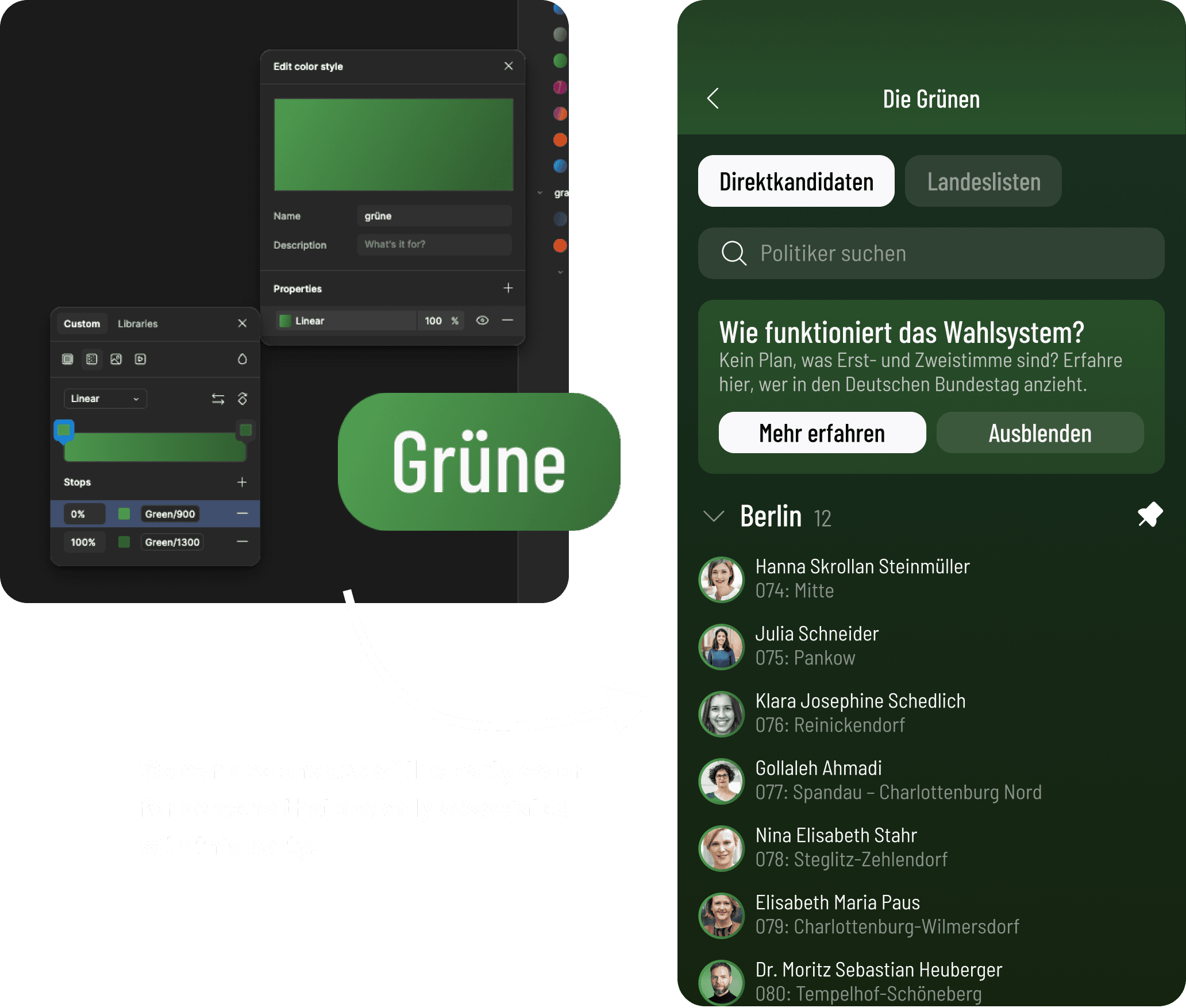
Every party get’s a whole color palette based on their party color that determines the custom gradients and page themes.
These are the most important parties with their labels (found e.g. in the profile)


Many Figma sessions later…
The Home Feed
Swipe through the current debates


Upcoming elections
Which elections are up next?


Politician Profile
The politician behind the posters


Search & Scan
Find relevant profiles quickly


Reflection
The strongest lesson sits in the four years between the two acts.
We launched FaceTheFacts days before an election. It went viral, hit 30k downloads, and reached the front page of r/de. Then we lived with its flaws: the dense screens, the biography no one read, …
For four years I knew the debt was there. Choosing it as my capstone meant facing my own work with fresh evidence and overruling decisions I once argued for.
Choosing it as my capstone meant facing my own work with fresh evidence and overruling decisions I once argued for.
A launch is not a finish line. Designs carry an expiry date. Feedback has a right time too: too early and it misleads, too late and it costs a rebuild.
The deeper reason I keep returning is the mission.
Democratic decisions are strongest when informed.
I want information to serve as a basis for questioning the narratives around us, not as a final answer. Building toward this goal is work I care about, and it shapes how I choose projects now.